Turning on & changing Translated Closed Captions on Zoom
PLEASE NOTE: At the account (or user) level, Closed captioning must be enabled in the Zoom account settings first. If it’s turned off at the account level, no one will be able to turn it on in a meeting.
When you enter a convention meeting and want to see closed captions, please follow these steps…
TURNING ON CLOSED CAPTIONING
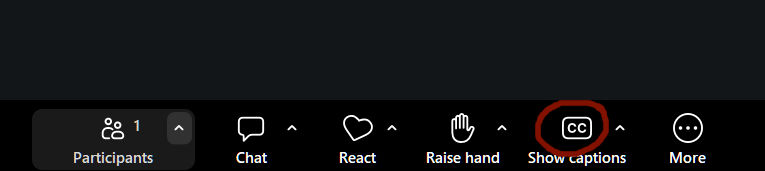
1. LOOK AT BOTTOM TASK BAR When in a Zoom Meeting, at the bottom of your screen you will see a task bar.
2. CLICK ON THE CC BUTTON On the Task bar, you will find the Closed Captions button. Click on it once.
If there is not an icon there of “Show captions”, click the round circle with 3 dots with the word “More” underneath. Select “Captions” there. Click once.
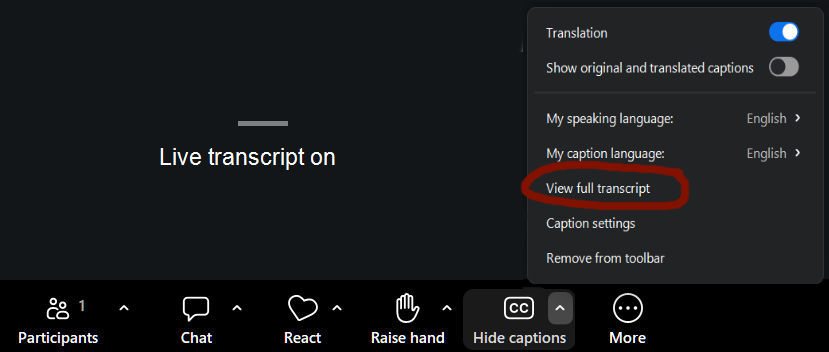
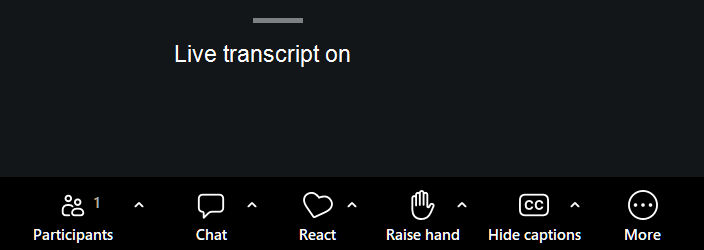
If done properly, the words under the “CC” icon will change to “Hide captions” and “Live transcript on” will appear on your window.
As soon as anyone talks, you will see whatever is being said in English (default language of Zoom).
PLEASE NOTE: If at any time you wish to turn off closed captions, Just hit the “CC” icon with “Hide caption“. You can always click the “CC” icon with “Show captions” again and it will appear.
Now proceed to the section to change translation to your own language…
TURNING ON CLOSED CAPTIONS FOR TRANSLATION
You learned how to turn on (or off) closed captioning above. Now you will learn how to change the closed captioning to your own language so that when you hear a speaker who doesn’t speak your language, you will be able to read what they are saying in your own language.
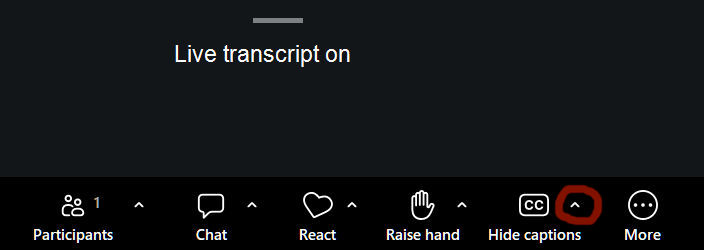
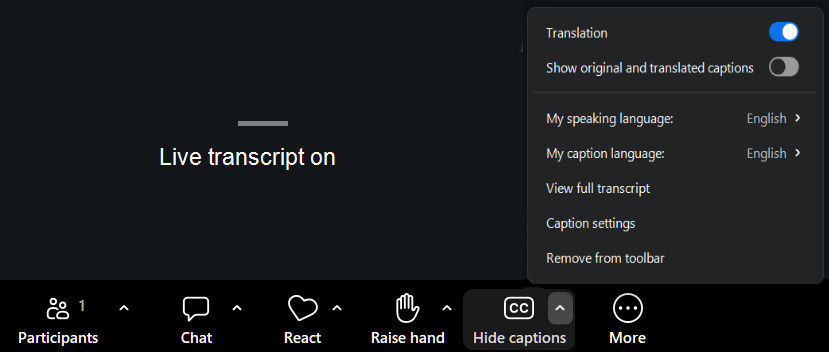
1. CLICK To the Right of the CC BUTTON On the Task bar you will find to the right of the Closed Captions (CC) icon a “tent-arrow-up”. Click on it.
A window will open up
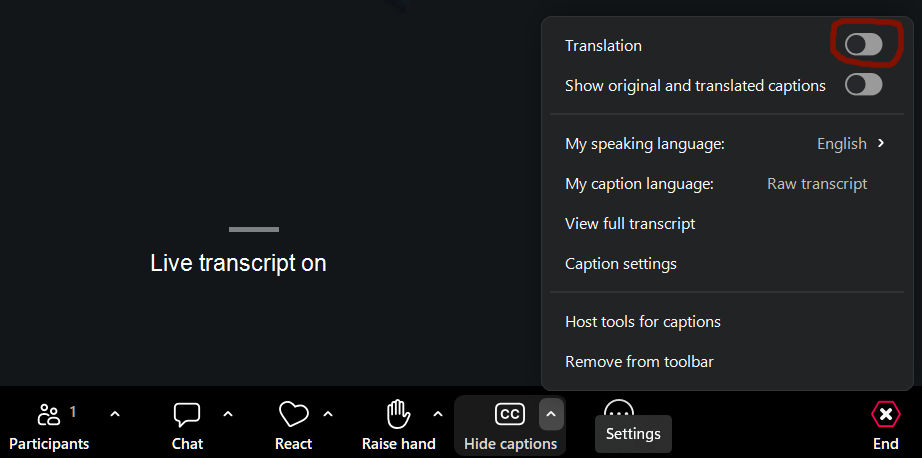
2. CLICK TRANSLATION On the pop up window, choose the first option, “Translation”. This needs to be turned on.
Slide the button shown to the right.
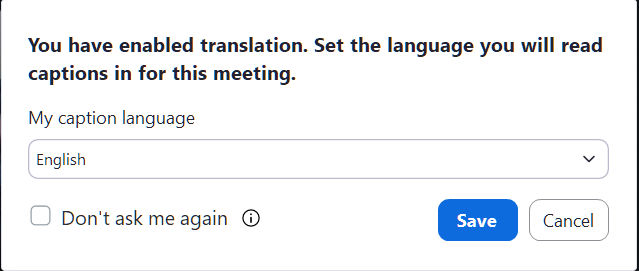
Another window will appear.
3. CHOOSE “My Caption Language” On the pop up window, choose the language you speak by clicking the drop down arrow.
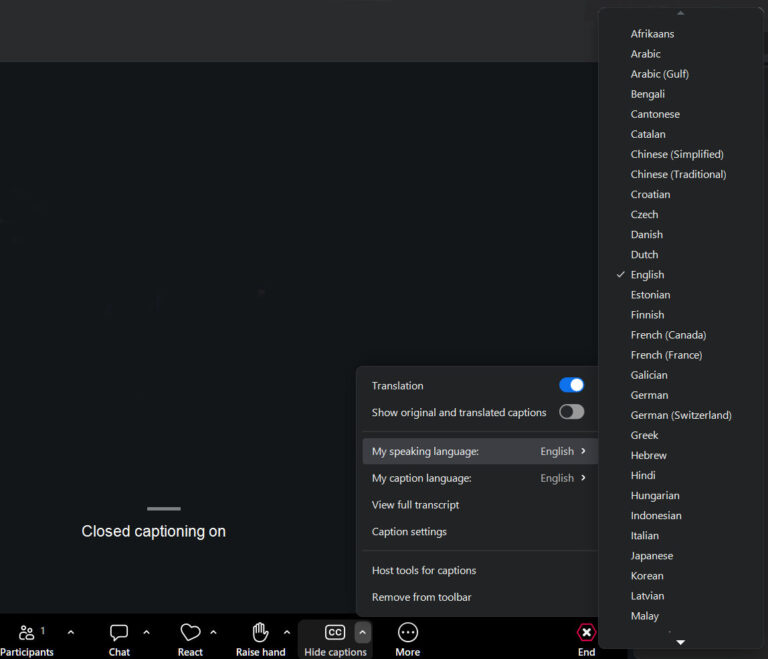
A window will open with different languages to choose from.
Then hit the blue save button.
You will see that the Translation button is now blue. It is now turned on.
4. DOUBLE CHECK SPEAKING LANGUAGE Under the list on the pop out window, Check to make sure “My speaking language” is your language. If not, change it by clicking on arrow and choosing your language.
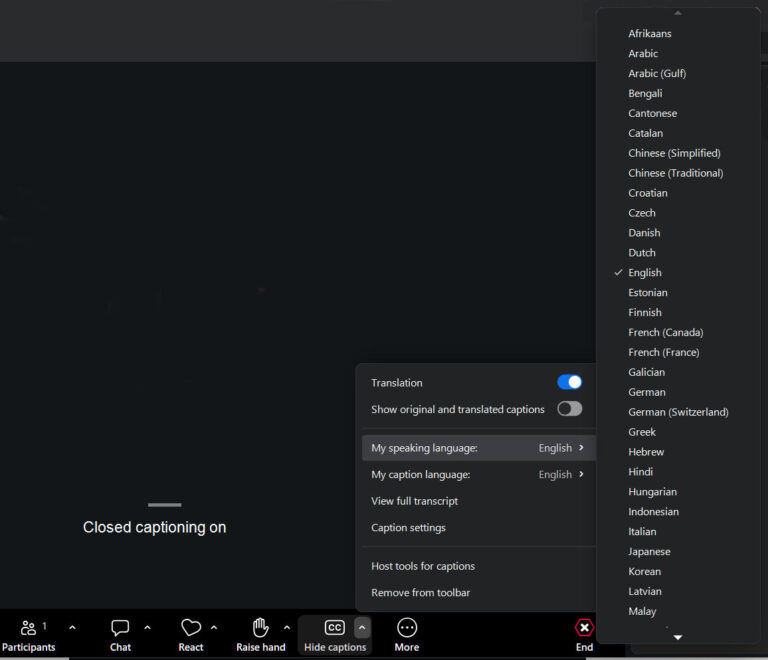
5. DOUBLE CHECK CAPTION LANGUAGE Under the list on the pop out window, check to make sure “My caption language” is your language. If not, change it by clicking on arrow and choosing your language.
YOU WILL NOW SEE THE CLOSED CAPTIONS IN YOUR OWN LANGUAGE.
WHENEVER ANYONE SPEAKS, IF a SPEAKER SPEAKS IN A DIFFERENT LANGUAGE, YOU WILL READ IT IN YOUR OWN LANGUAGE.
We hope this tutorial will help you.
Zoom Artificial Intelligence (AI)
is what is used to provide real-time captions and translations.
Important: Help AI stay correct!
The AI is very smart, but it can get confused.
Speak only in your selected language.
If you switch languages mid-sentence, the captions will become confusing!
Speak slowly and clearly.
This year we are providing caption and transcription capability in 46 languages. Most languages of convention attendees work well with the AI.
Some OA terms are hard for the AI.
English to other language translation is supported, but translation from some other languages to English may be limited.
Using a Phone or Tablet?
1.Tap your screen to see the menu.
2.Tap the three dots (…) labelled “More.”
3.Tap “Captions.”
4.Select your Speaking Language and your Translation language.
Tips for Success:
To See the whole conversation: Click the arrow next to Captions and select “View Full Transcript” to see a scrolling window of everything spoken so far.
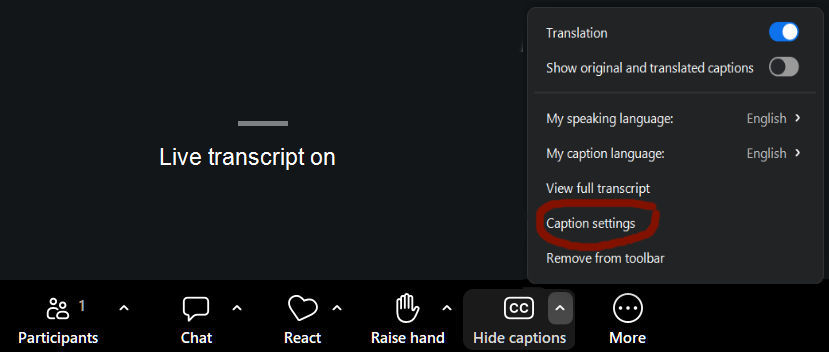
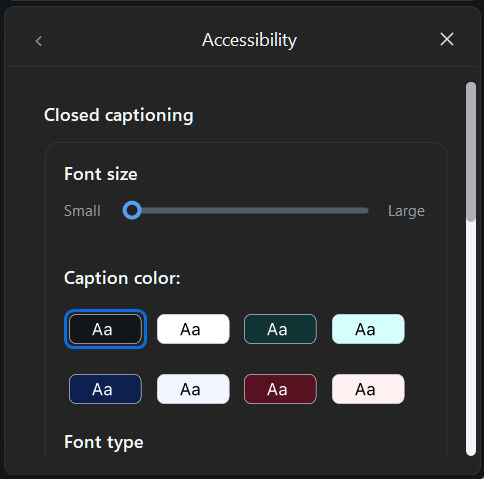
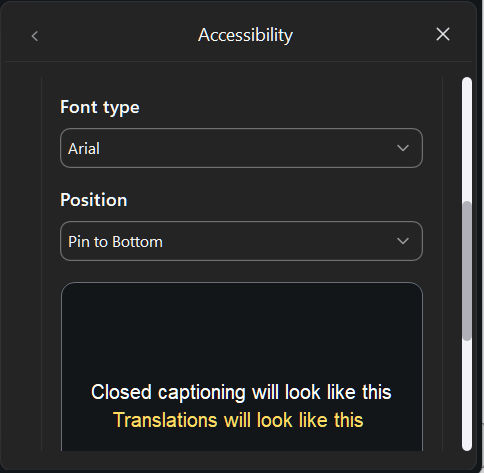
Change Text Size: If the words are too small, go to “Caption Settings” in that same menu to make the text larger.




 Using a Phone or Tablet?